The first post in this blog will be about the history of soap. I know that it is kind of a cliché to always start by researching the history of something, but I am a firm believer in the powers of time to filter the useless and keep the useful. So, here I summarized the history of cleaning systems in general and soaps in particular.
N.B.: Please, keep in mind that the information here is based on scientific articles available at the time of publishing, if future research shows that some of the info here is incorrect or incomplete, I will try and update it.
Soap is one of the few compounds that survived and thrived with time, proving that it is a human necessity, one that cannot be easily discarded. Even though it was considered a precious item and sometimes sacred, there has been no wars over it (to the best of my knowledge) which makes its history all the more interesting.
Soap’s origins are unknown or when or what civilization made soap for the first time or how did they discover the process. To make things more complicated, some organic matter becomes soap in certain conditions, so it is difficult and even impossible to know if the residues found on archeological items are from organic matter or actual soap (Konkol and Rasmussen 2015). Most of the current knowledge about ancient soaps and soapmaking comes from surviving writings.
The oldest inscription mentioning soap is found in Mesopotamia, it is from 2200 BC (Konkol and Rasmussen 2015) and one of the earliest names of soap (even though it is still disputed) is the hieroglyphic “Anzir” and it was found in a Demotic papyri (Konkol and Rasmussen 2015; Levey 1954). Other names for soap in different languages are presented in Table 1.
| Language | Translation |
| Latin | Sapo |
| Greek | Sapon |
| German/Middle High German | Seife |
| Old High German | Seiffa |
| Middle Low German | Sepe |
| Finnish | Saippua |
| Hungarian | Szappan |
| Dutch | Zeep |
| Arabic/Persian/Turkish | Sabun |
| Hebrew | Sabon |
| French | Savon |
| Spanish | Jabón |
| Italian | Sapone |
| English | Soap |
| Bengali/Hindi/other Indian languages | Saban |
| Polish | Mixdo |
| Russian | Milo |
Even though soap has been made for a very long time, the chemical reaction that produces soap was described for the first time by Michel Eugene Chevreul who is a French chemist in his “Recherches Chimiques: Les Corps Gras d’Origine Animale” (Chevreul 1823). As you may already know, the chemical reaction to make soap is an easy one, the saponification reaction consists of mixing oils and fats with alkaline compounds. Fats where known since forever, oils are relatively new – sesame, linseed, and castor oil were pressed in Egypt since 259 BC preceded only by cottonseed oil in India and China from the prehistoric era (Blank 1942). Alkaline compounds were less known and were highly dependent on the region. Some civilizations used alkaline plants (Table 2) and others used extracts from alkaline lakes such as lake Van in Turkey and alkaline extracts from dried lakes such as the dried lakes of Wadi El Natrun in Egypt.
| Region | Plant |
| Near East | Salicornia |
| Salsola | |
| Mesembryanthemum | |
| Saponaria | |
| Stattice | |
| Atriplex | |
| India | Melia azadirachta |
| Silk cotton (genera Bombax and Ceiba) | |
| Musa paradisiaca | |
| Soapnut | |
| Peru and Chile | Quillaia |
| Saponaria | |
| Molina | |
| Angola | Sphenostylis stenocarp |
| Carica papaya | |
| Ximenia americana | |
| Pteridium aquilinum | |
| Solanum aculeastrum | |
| Sebasnia bispinosa |
Several routes to clean oils and fat residues from the skin were developed. The first one is by scraping, Neolithic people used flint scrapers and the Greeks and Romans scrubbed with a Strigil (Figure 1) or scraped their skin with scrapers made from bone, ivory or metal (Routh et al. 1996).
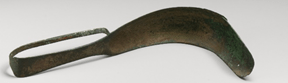
The second route was using a powder such as clays and ash that absorbs oily and fatty residue. Cleaning with ash may have led to the third route which consists of washing using a dilute alkaline solution (which usually consists of water and ash from alkaline plants), the alkaline solution will saponify the oils and fats which will later help in the dissolution of more fats and oils. The fourth route is by using soap which is milder on the skin and clothing but at the time much more difficult to make and mostly limited to the rich and for ritualistic purposes. (Konkol and Rasmussen 2015; Levey 1954, 1958).
Soap began to be mass produced in 800-850 A.D. in Germany, followed by Marseille, France in 800-900 A.D. and in 1300-1400 A.D. in England (Blank 1942). This reflects the social importance of soap, and the need to clean and be clean. Recently, many technical advancements were made in the mass production of soaps (G. Mazzoni 1946; A. F. Mazzoni 1981; Hoyt 1931; Travis 1928), and a diversification of the use of soaps with the introduction of additives for different applications.
References:
Blank, Eugene W. 1942. “Chronological List of Important Dates in the History of the Fats and Waxes.” Oil & Soap 19 (6): 110–13. https://doi.org/10.1007/BF02630670.
Chevreul, Michel Eugene. 1823. Recherches Chimiques: Les Corps Gras d’Origine Animale. https://ia802606.us.archive.org/35/items/rechercheschimi00chevgoog/rechercheschimi00chevgoog.pdf.
Hoyt, Lester F. 1931. Soap, issued 1931.
Konkol, Kristine L., and Seth C. Rasmussen. 2015. “An Ancient Cleanser: Soap Production and Use in Antiquity.” In ACS Symposium Series, 1211:245–66. https://doi.org/10.1021/bk-2015-1211.ch009.
Levey, Martin. 1954. “The Early History of Detergent Substances.” Journal of Chemical Education 31 (1): 521–24.
———. 1958. “Gypsum, Salt and Soda in Ancient Mesopotamian Chemical Technology.” Isis 49 (3): 336–42. https://doi.org/10.1086/348678.
Mazzoni, Aldo F. 1981. High efficiency, fast extruders for extruding and refining soap and detergents., issued 1981.
Mazzoni, Giuseppe. 1946. Process of drying Soap, issued 1946.
MET Museum. 2019. “Bronze Strigil (Scraper).” 2019. https://www.metmuseum.org/art/collection/search/248881.
Routh, Hirak Behari, Kazal Rekha Bhowmik, Lawrence Charles Parish, and Joseph A. Witkowski. 1996. “Soaps: From the Phoenicians to the 20th Century—A Historical Review.” Clinics in Dermatology 14 (1): 3–6. https://doi.org/10.1016/0738-081X(95)00101-K.
Travis, Pierce M. 1928. Process and Apparatus for Manufacturing Soap, issued 1928.
 SoapMaker's Journal