Whether you have made it or used it or heard of it, this soap is the holy grail of soaps, those who have used it swear by it, and this is for many reasons that I will be discussing in this article. (Warning: it might get too technical, but I will try to keep it fun).
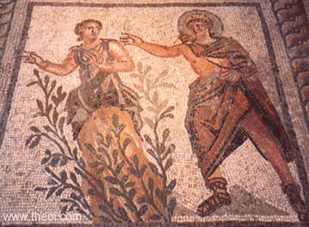
First of all, and as always, I will start with a little history, Aleppo soap is made from Laurel berry oil, a product of the noble Laurel tree. It is a noble tree because you can trace its sapline (not sure if it is a word, but it should be) back to the Greek gods, where Hera metamorphosed Daphoene/Daphne into a Laurel tree (or replaced her with a Laurel tree after hiding her, depending on the reference) to protect her from Apollo who wanted to rape her (Graves 2017). Not only the Greeks cherished this tree and had priestesses get high from shewing its leaves, but also the Romans liked it and considered its leaves a protection talisman (especially from lightnings) and even Emperor Tiberius wore it on his head (McCartney 1929). So, a tree mentioned in the Greek mythology and worn by a roman emperor must be unique and important, and I will show you why in this article, at least from a chemical and soapmaker’s point of view.
From the Laurel tree comes the Laurel berry oil. It should be noted that two types of oils can be extracted from the laurel tree, the first one is the essential oil which is mainly extracted from the leaves by steam distillation though other methods exist (Taban, Saharkhiz, and Niakousari 2018). The other oil or fat is extracted from the berries, and it is not essential (which means that it is mainly constituted of triglycerides) and can be saponified. The Laurel berry oil is extracted traditionally by boiling the berries in water, this process will extract the oils and make them float on the surface of the water, at the end it is cooled till the oil solidifies, it is then collected and dried (Global Facilitation Unit for Underutilized Species, n.d.; “The Laurel Tree in Syria” 2005). The oil in itself is used to treat certain skin ailments, sore muscles and rheumatism, it should be noted that the literature on the therapeutic benefits of Laurel berry oil is scant and it is mainly used in folk medicine.
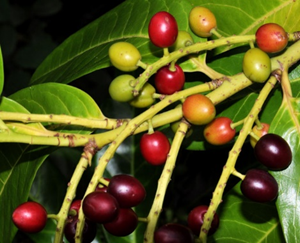
The laurel berry oil is a peculiar oil, it is in a class all by itself, let me explain to you more about this peculiarity. Oils extracted from natural sources such as sunflower oil or coconut oil have a fatty acid profile that varies according to several factors such as the region, the species, the water, the climate. Those factors make it impossible for the consumer to have a constant fatty acid profile for an oil. So, the only constant thing that the consumer can rely on is that the type of the oil will be the same. By type, I use the same definition as Kevin Dunn in his book: Scientific Soap Making (Dunn 2010), in which he classifies the oils by their dominant fatty acid, for example: olive oil is an oleic oil (dominant fatty acid is oleic acid), coconut oil is a lauric oil (dominant fatty acid is lauric acid), … When the time comes to classify the Laurel berry oil, you will find that some references list that the dominant fatty acid is lauric acid while other references show that it is the oleic acid. So, to what type does this oil belong and who is right and who is wrong? As a matter of fact, they are all right, and here comes the peculiarity of this oil. It was observed the first time by Geoffrey Collin in 1931 (Collin 1931) where he noted that the berries are initially rich in lauric acid, and as the berries ripen oleic acid starts to appear. This observation was further developed by Abdul Aziz Ramadan et al. in 2017 (Ramadan, Mandil, and Anadani 2017) who studied the fatty acid profile of berries of each color for three months. This showed that the riper the berry and the darker the color, the richer it is in oleic acid, and the younger the berry and the greener the color the richer it is in lauric acid. Moreover, the genotype of the Laurel tree plays a considerable role in the final fatty acid profile of the oil, as shown by Filiz Ayanoğlu et al. in 2018 (Ayanoğlu, Kaya, and Koçer 2018).
So, ladies and gentlemen, I present to you the first and only oil (to the best of my knowledge) that belongs to two types depending on the maturity of the berries, and with enough effort, time and money, it can be collected at a time where the lauric and oleic acids have a ratio of 1 and thus belong to the two types simultaneously. This duality of types makes it a remarkably interesting oil for soapmaking.
All soapmakers whether hobbyists or professionals design their soaps to have maximum foam for the user’s (or marketing department’s) pleasure and enough cleansing because after all that what soaps are supposed to do. For this end, two fatty acids are mainly controlled, the lauric acid that gives the best foam, and the oleic acid that gives the best cleansing and coincidentally those two fatty acids when present at a certain ratio, they have a compounding effect where the soap gives the best and most stable foam with enough cleansing for the soap to do its job (Spitz 2016). Commercial soaps are usually made with palm oil which is a palmitic oil (rich in palmitic acid and contains enough oleic acid) and palm kernel oil or coconut oil which are both lauric oils (rich in lauric acid). So, whether industrially or as a hobby any soapmaker knows that there is a need to at least two oils to make a good soap (unless you are making castile soap, which will be discussed in another article). This need can be eliminated with a carefully chosen laurel oil, I say carefully because the laurel berries should be gathered and processed at a time when the lauric and oleic acids are at the needed ratio. A soap made with such an oil will have the properties usually obtained with two oils with the added value of having a dark yellow color with a green inside and that reeks of laurel (yes, the fat from the berries contains a little essential oil).
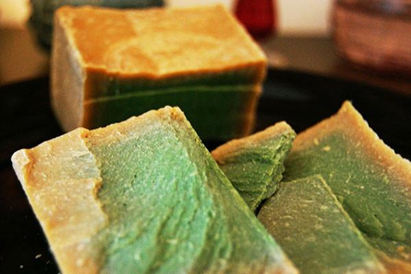
Laurel oil soap is an incredibly old soap that has been made traditionally in the Near East region, it is also known as Aleppo soap. This soap has been made for a couple thousands of years at least, it is difficult to know exactly since no record exists or has been found yet. As with everything in this area, the know-how is a family secret that is transmitted from parent to child, and even to this day it is manufactured according to ancestral formulations and traditions and is limited to a number of families. The secret kept in the family usually involves the date for collecting the berries, the oil extraction method, and the soapmaking ratios. Initially the soap is green, but after some time curing, the exterior becomes dark yellow, but the interior remains green as shown in Figure 3 and it is rock hard with a characteristic smell. It is a weird business model, where the factory is open for a couple of weeks a year, when everything is manufactured, then wait at least 6 months to begin to sell the soaps, but somehow it works and everybody is happy that it does.
If you haven’t used or tried a true Aleppo soap, I recommend that you add it to your bucket list. It is not only a soap that cleanses, it is an experience in itself, and if you have the capacity to make one, do not hesitate for a second.
References:
Atsma, Aaron J. 2017. “DAPHNE & APOLLO.” 2017. https://www.theoi.com/Gallery/Z5.1.html.
Ayanoğlu, Filiz, Durmuş Alpaslan Kaya, and Oğuzhan Koçer. 2018. “Promising Bay Laurel (Laurus Nobilis L.) Genotypes for Fruit Production.” International Journal of Chemistry and Technology 2 (2): 161–67. https://doi.org/10.32571/ijct.485896.
Bridge, Albert. 2011. “Laurel Tree Berries.” 2011. https://www.geograph.ie/photo/2554451.
Collin, Geoffrey. 1931. “Some Peculiarities in the Glyceride Structure of Laurel Fats.” Biochemical Journal 25 (1): 95–100. https://doi.org/10.1042/bj0250095.
Dunn, Kevin M. 2010. Scientific Soapmaking: The Chemistry of the Cold Process. Clavicula Press. http://cavemanchemistry.com/scisoap/index.html.
Global Facilitation Unit for Underutilized Species. n.d. “Laurel (Laurus Nobilis).” http://www.underutilized-species.org/species/brochures/Laurel.pdf.
Graves, Robert. 2017. The Greek Myths: The Complete and Definitive Edition.
McCartney, Eugene S. 1929. “Why Did Tiberius Wear Laurel in the Form of a Crown during Thunderstorms?” Classical Philology 24 (2): 201–3. https://doi.org/10.1086/361124.
Ramadan, Abdul Aziz, Hasna Mandil, and Lina Anadani. 2017. “Effect of Ripening Time of Fruits in the Chemical Composition (%) of Fatty Acids in Syrian Laurel Oil.” International Journal of Current Research in Chemistry and Pharmaceutical Sciences 4 (12): 29–33. https://doi.org/10.22192/ijcrcps.2019.06.07.004.
Spitz, Luis. 2016. Soap Manufacturing Technology. Soap Manufacturing Technology. https://doi.org/10.1016/c2015-0-00078-8.
Taban, Azin, Mohammad Jamal Saharkhiz, and Mehrdad Niakousari. 2018. “Sweet Bay (Laurus Nobilis L.) Essential Oil and Its Chemical Composition, Antioxidant Activity and Leaf Micromorphology under Different Extraction Methods.” Sustainable Chemistry and Pharmacy 9 (February): 12–18. https://doi.org/10.1016/j.scp.2018.05.001.
“The Laurel Tree in Syria.” 2005. International Plant Genetic Resources Institute.
 SoapMaker's Journal